Most homeowners think of bathroom ventilation as a minor convenience that simply clears a mirror after a hot shower. What often goes unnoticed is that every shower releases a concentrated burst of moisture into a confined space. Without proper ventilation, that moisture does not disappear.
It migrates into ceilings, wall cavities, insulation, and attic spaces. Understanding how ventilation works and why it matters is one of the most important steps in protecting a home from long-term moisture damage and structural failure.
Why Ventilation is a Critical Moisture Control System
Bathroom ventilation is a primary moisture control system rather than a comfort feature. Its technical purpose is to remove humid air at the source before it can condense on building materials. When ventilation is inadequate, moisture lingers.
That lingering humidity increases the risk of mold amplification, insulation compression, peeling paint, and gradual wood deterioration. Even small amounts of repeated condensation can create long-term structural consequences.
Moisture problems often develop slowly and quietly, making early detection difficult without a professional inspection. Because water vapor is a gas, it can move through drywall via capillary action and vapor diffusion, meaning the damage is often hidden behind the surfaces you see every day.
The Science of Condensation and Property Decay
Warm air holds significantly more moisture than cool air. During a hot shower, the relative humidity in a bathroom can approach saturation. When that moisture-heavy air comes into contact with cooler surfaces such as drywall, attic sheathing, or exterior walls, the air temperature drops and condensation forms.
If those materials remain damp for 24 to 48 hours, microbial growth becomes a mathematical certainty. Mold spreads by releasing microscopic spores into the air. Professional air sampling measures these concentrations in spores per cubic meter.
When indoor levels significantly exceed outdoor control samples, it indicates potential interior growth. Ventilation interrupts this cycle by removing moisture before it can settle into materials and initiate damage.
Technical Requirements for Effective Ventilation
A fan that makes noise is not necessarily a fan that works. To effectively protect a property, a ventilation system must meet specific mechanical criteria.
Airflow and Capacity Standards
| Feature | Requirement | Impact on Property Health |
| Airflow Rating | Minimum 1 CFM per square foot | Ensures the volume of air is replaced quickly enough to prevent condensation. |
| Duct Termination | Must exit the building envelope | Prevents moisture from being dumped into attics or crawlspaces. |
| Duct Material | Rigid metal preferred | Reduces friction and static pressure for maximum fan efficiency. |
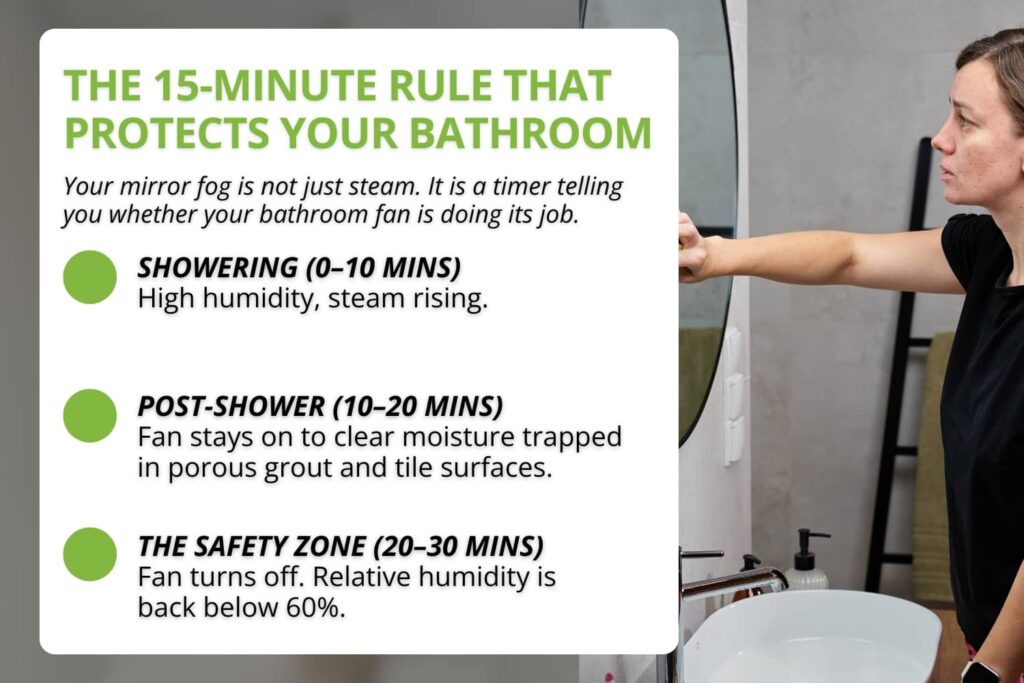
| Run Time | 20 to 30 minutes post-shower | Removes latent moisture that remains on surfaces after the water is turned off. |
Direct Exterior Exhaust and Duct Integrity
Moist air must be vented entirely outdoors. Venting into an attic, wall cavity, or crawlspace allows moisture to accumulate in concealed spaces. This frequently results in darkened roof decking and damp insulation.
Uninsulated ducts allow warm air to cool quickly, leading to internal condensation within the pipe itself. Sagging ducts create low points where water collects, potentially causing ceiling stains or mechanical equipment failure.
The Impact of Chronic Moisture on Structural Components
Persistent humidity affects more than just surface finishes. Attic spaces are especially vulnerable when exhaust systems are improperly terminated. Repeated moisture exposure can cause roof sheathing to delaminate and weaken.
Damp insulation loses its R-value, which refers to its thermal resistance, leading to increased energy costs and uneven indoor temperatures.
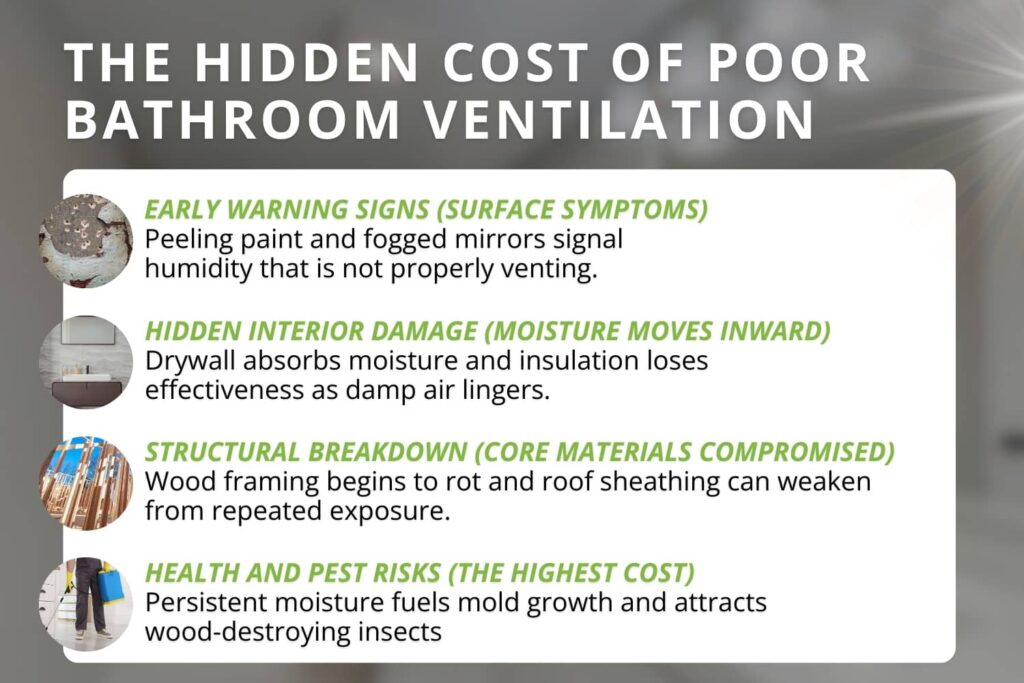
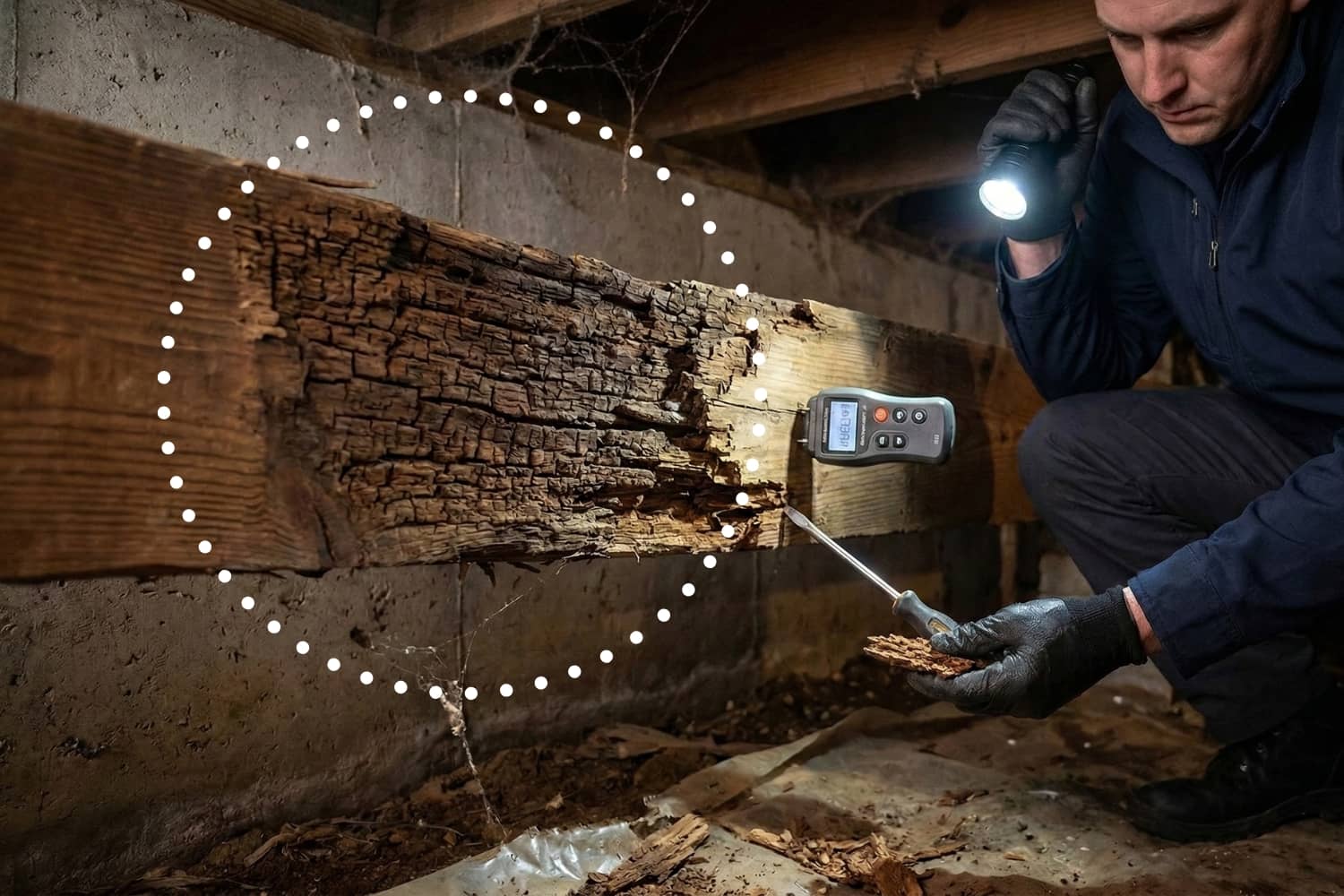
Moist conditions also create an environment conducive to wood-destroying insects. During a professional inspection, experts look for mud tubes, softened wood, and frass, which is the debris left behind by wood-boring pests.
While ventilation problems alone do not cause infestations, excess moisture increases the structural vulnerability of the home, making it a more attractive target for pests that thrive in damp wood.
Professional Evaluation Tools
Identifying moisture problems requires specialized tools and training. At National Inspection Service of Indiana (NISI), we use advanced technology to see what the naked eye cannot.
- Thermal Imaging: Infrared cameras reveal temperature anomalies. Cold spots in walls or ceilings often indicate hidden moisture or failing insulation caused by condensation.
- Moisture Meters: These devices measure the actual moisture content of drywall and framing materials. This allows an inspector to determine if a stain is “active” or if a wall is holding water behind the paint.
- Hygrometers: These tools measure indoor humidity and dew point. If indoor humidity levels remain above 60% consistently, the environment is primed for mold growth.
- Continuous Radon Monitors: While bathroom fans are not for radon mitigation, overall airflow balance influences indoor air dynamics. Radon is measured in picocuries per liter, and proper air exchange is a key component of a healthy home.
DIY Observations vs Professional Inspection
Homeowners can monitor for warning signs such as lingering steam, peeling paint, or exterior vent flaps that fail to open when the fan is running. Cleaning dust from fan grilles is a helpful maintenance step. However, repeated moisture damage or persistent musty odors require a professional evaluation.
A licensed inspection evaluates the full moisture management system. This includes checking the attic for mold “ghosting” on rafters and verifying that the fan is actually moving the rated amount of air.
| Sign of Trouble | Potential Cause | Professional Action |
| Yellow Ceiling Rings | Leaking duct or condensation | Thermal imaging to trace the moisture source. |
| Bubbling Paint | High vapor pressure behind paint | Moisture meter probing to check drywall saturation. |
| Mirror Fogging > 15 min | Undersized CFM or clogged duct | Airflow velocity testing at the intake grille. |
Related Questions
How long should I leave my bathroom fan running?
You should let the fan run for at least 20 to 30 minutes after you finish bathing. This ensures that the moisture remaining on the shower walls and floor is evaporated and exhausted before it can soak into the drywall or cabinetry.
Can I vent my bathroom fan into the attic if I have a roof vent nearby?
No. This is a common construction error. Moist air is heavy and will often settle on the underside of the roof sheathing before it can reach a roof vent. This leads to wood rot and mold growth on the rafters. All fans must be directly ducted to the exterior of the home.
Why does my bathroom smell musty even though I use the fan?
A musty smell usually indicates that mold has already begun to grow in a hidden area, such as behind the shower tile or in the wall cavity. It could also mean the fan is not moving enough air to lower the humidity below the 60% threshold required to stop microbial growth.
Does a bathroom window provide enough ventilation?
While a window provides a path for air, it relies on natural pressure differences, which are often insufficient. In many climates, opening a window can actually introduce more humidity into the home. A mechanical exhaust fan is the only reliable way to ensure consistent moisture removal.
Conclusion
Bathroom ventilation is a preventative system that protects structural components, insulation performance, and indoor air quality. Addressing ventilation issues early prevents hidden damage that can become expensive over time.
If you suspect ventilation problems or possible mold growth, schedule a professional evaluation today. Book your inspection at NISI and ensure your home’s moisture control system is operating at peak performance.