A radonA radon test result below 4.0 pCi/L generally falls within the range the EPA considers acceptable. But the number alone doesn’t tell the whole story. At National Inspection Service of Indiana (NISI), we compile hundreds of radon reports a year for homeowners across Evansville and Newburgh. The question we hear most after testing is simple: what does this number actually mean for me? This guide covers how to read your radon test results, what average levels look like in Southern Indiana, and what to do next, whether your reading is low, borderline, or high.
How to Read Your Radon Test Number
Radon test results use picocuries per liter of air, written as pCi/L. This unit measures the radioactivity your test kit or monitor picked up, and it’s the standard measurement for both short-term and long-term testing in the U.S.
Short-term vs. long-term tests
Testers use two common methods:
- Short-term test: Runs for 2 to 7 days using a passive kit or continuous monitor. Fast, but more sensitive to short-term swings in weather and ventilation.
- Long-term test: Runs for 90 days to a year. It gives a more accurate picture of your home’s year-round average, since radon levels shift with the seasons.
How NISI tests your home
NISI places a continuous radon monitor in the lowest livable level of your home for 48 hours. The monitor takes a reading every hour. Your final report averages those readings, not a single moment-in-time number. A home’s radon level naturally fluctuates with air pressure, ventilation, and the weather during the test window. That’s why the testing process itself matters as much as the final figure.
Radon comes from the natural breakdown of uranium in soil and rock. It enters homes through foundation cracks, sump pits, and gaps around pipes. Radon has no odor and no color, so testing is the only way to know your actual exposure, no matter how new or old your home is.
What Counts as a Safe, Borderline, or High Radon Level
Most experts consider a radon level under 2.0 pCi/L low risk. A result between 2.0 and 3.9 pCi/L falls into a range the EPA says is worth watching. Anything at or above 4.0 pCi/L hits the EPA’s official action level, where the agency recommends mitigation.
| Your result (pCi/L) | What it means | Recommended next step |
|---|---|---|
| Below 2.0 | Low relative risk | No immediate action; retest every 2 years or after major renovations |
| 2.0 – 3.9 | EPA “consider action” range | Consider a long-term test or mitigation, especially for extended time spent at that level |
| 4.0 and above | EPA action level | Mitigation is recommended; a second test can confirm before you commit to a system |
A few things worth keeping in mind
A single short-term test near the 4.0 line is worth confirming. If your result lands close to the action level, run a second test. Either a short-term or long-term follow-up gives you a clearer picture before you decide on mitigation.
There’s no truly “zero-risk” level. The national average indoor radon reading is about 1.3 pCi/L. Outdoor air typically measures around 0.4 pCi/L. So even homes well under the action level still carry some radon.
The World Health Organization sets a lower threshold than the EPA: around 2.7 pCi/L instead of 4.0 pCi/L. Some homeowners choose to mitigate at that lower number, especially if they spend a lot of time in a basement or lowest-level living space.
Average Radon Levels in Evansville and Vanderburgh County
Vanderburgh County sits in the EPA’s Radon Zone 2. That means the predicted average indoor screening level for the area falls between 2 and 4 pCi/L, the same “consider action” range described above.
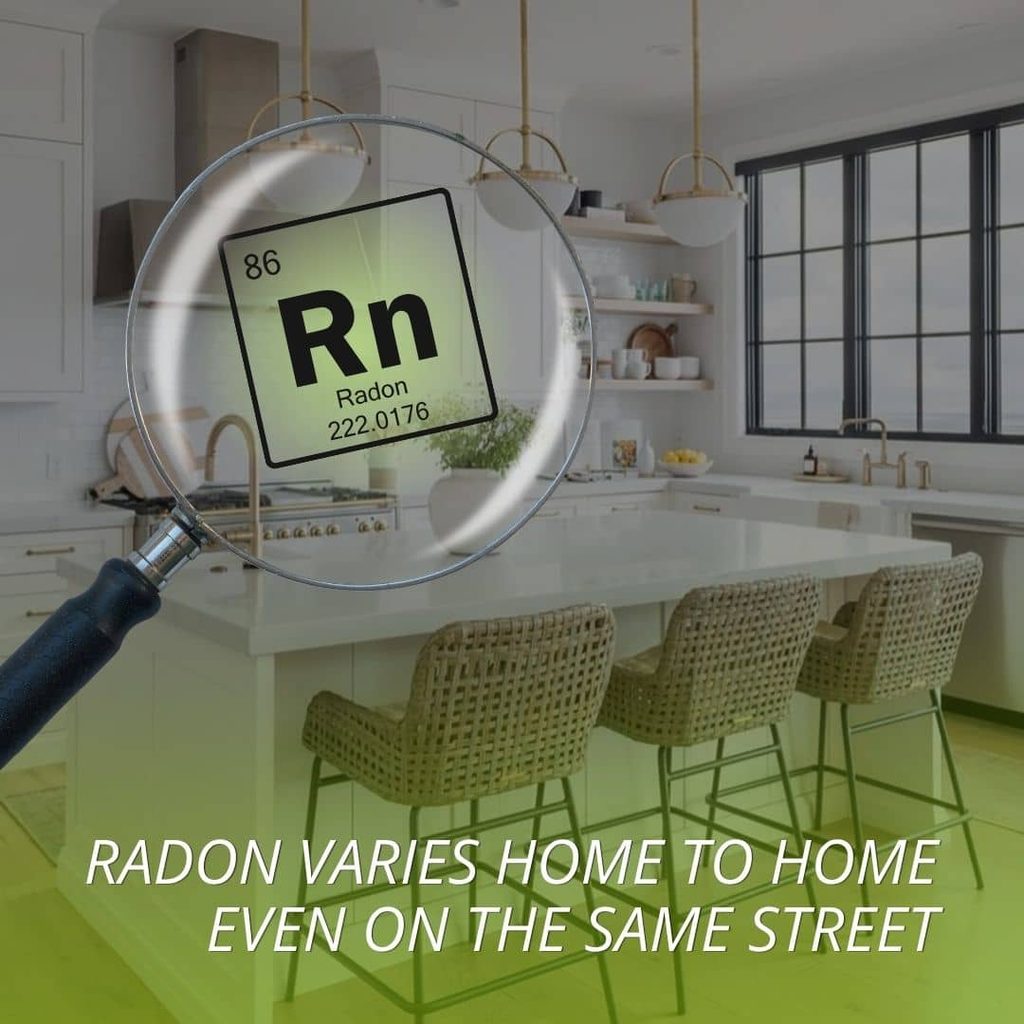
That’s a county-level prediction, not a guarantee about any individual home. Radon levels can vary significantly from one house to the next, even on the same street. Soil conditions, foundation type, and construction details under each specific home drive that variation. The Indiana Department of Health estimates that nearly one in three Indiana homes tests at or above the EPA’s 4.0 pCi/L action level statewide.
EPA’s Map of Radon Zones shows most of the state, including much of Southern Indiana, carrying moderate to high radon potential.
What Does This Mean For Your Home?
Living in a Zone 2 county doesn’t tell you whether your home is elevated. It only tells you the odds run higher than in a low-potential area. That’s exactly why the EPA and the Indiana Department of Health both recommend testing every home instead of relying on the zone map alone.
What Happens After You Get Your Results
What you do next depends entirely on where your number falls, but a good result doesn’t mean you’re finished with radon for good.
If your result is low (under 2.0 pCi/L): No action is needed right now. The EPA still recommends retesting every two years, and definitely after any renovation that changes airflow, adds a finished basement, or disturbs the foundation.
If your result is borderline (2.0–3.9 pCi/L): Consider a longer-term follow-up test to see whether the number holds steady across seasons. Some homeowners choose to mitigate proactively in this range, especially if the home has a finished basement used as a bedroom or living space.
If your result is high (4.0 pCi/L or above): A radon mitigation system is the standard recommendation. These systems use a vent pipe and fan to pull radon from beneath the foundation and release it safely above the roofline, and they’re widely used, well-proven, and typically installed within a day. After installation, a follow-up test confirms the system brought levels down, usually to well under 2.0 pCi/L.
If the test was part of a home purchase, a high result doesn’t automatically end the deal. Buyers commonly use the report as part of negotiations, requesting the seller install a system, offer a credit toward mitigation, or adjust the price.
Related Questions to Explore
What is considered a safe radon level in a home? There’s no level considered completely risk-free, but the EPA sets 4.0 pCi/L as the threshold where action is recommended, and suggests considering action between 2.0 and 4.0 pCi/L as well. The national average indoor reading is about 1.3 pCi/L.
How long does it take to get radon test results back? A short-term continuous monitor test, like the one NISI uses, typically takes 48 hours to complete, with results available shortly after. Long-term tests, used for a more seasonal average, run for 90 days or more before results are compiled.
What should I do if my radon test comes back high? Start with a second test to confirm the reading, especially if it’s a short-term result. If the elevated level holds, a certified mitigation contractor can install a system, and NISI can help connect the results to next steps during that conversation.
Do I need a follow-up test if my result is close to 4.0 pCi/L? Yes, it’s a good idea. Results near the action level are the most likely to be affected by short-term fluctuations in weather or ventilation, so a second short-term test or a longer-term test gives a more reliable picture before you decide on mitigation.
What is the average radon level in Vanderburgh County? Vanderburgh County is designated EPA Radon Zone 2, with a predicted average indoor screening level between 2 and 4 pCi/L. Individual homes can still test above or below that range, which is why testing your specific home matters more than the county average.
Can radon affect a home sale in Evansville? Yes. Radon test results often come up during the home-buying process, and an elevated reading can lead to negotiation over mitigation costs, credits, or repairs before closing, even when testing isn’t legally required.
When to Talk to a Certified Radon Inspector
If you’re not sure whether your result calls for action, or you’re getting ready to test for the first time, talking to a certified radon professional takes the guesswork out of it.
A qualified inspector can:
- Explain exactly what your number means for your specific home and how you use it
- Recommend whether a follow-up or long-term test makes sense
- Walk you through mitigation options if your level comes back elevated
- Coordinate radon testing alongside a full home inspection to save time during a real estate transaction
NISI’s inspectors, including owner Rob Cahill, a Certified Radon Inspector, handle radon testing throughout Evansville, Newburgh, and the surrounding area, and can walk you through your results in plain language, not just a number on a page.
Conclusion
Your radon test result is a snapshot, not a life sentence for the house. A reading under 2.0 pCi/L means low relative risk, a result between 2.0 and 3.9 pCi/L is worth watching and possibly retesting, and anything at 4.0 pCi/L or above is the EPA’s signal to mitigate. In a Zone 2 county like Vanderburgh, testing your specific home is the only way to know where you actually land.
If you’ve got a number in hand and aren’t sure what it means for your situation, or you haven’t tested yet, reach out to NISI, and we’ll walk you through it.