The serial number on your air conditioner tells a trained inspector the unit’s age, manufacturing history, and whether its warranty may still apply.
When Rob Cahill and the team at National Inspection Service of Indiana inspect a home, the AC data plate is one of the first stops on the equipment walkthrough.
Knowing how to decode that string of letters and numbers helps buyers and sellers understand what they own, and what the inspection report means when it flags an aging system.
This post walks through where to find the serial number, how to read it by brand, and what it means for your home purchase in the Evansville area.
Where to Find the Serial Number on Your Air Conditioner
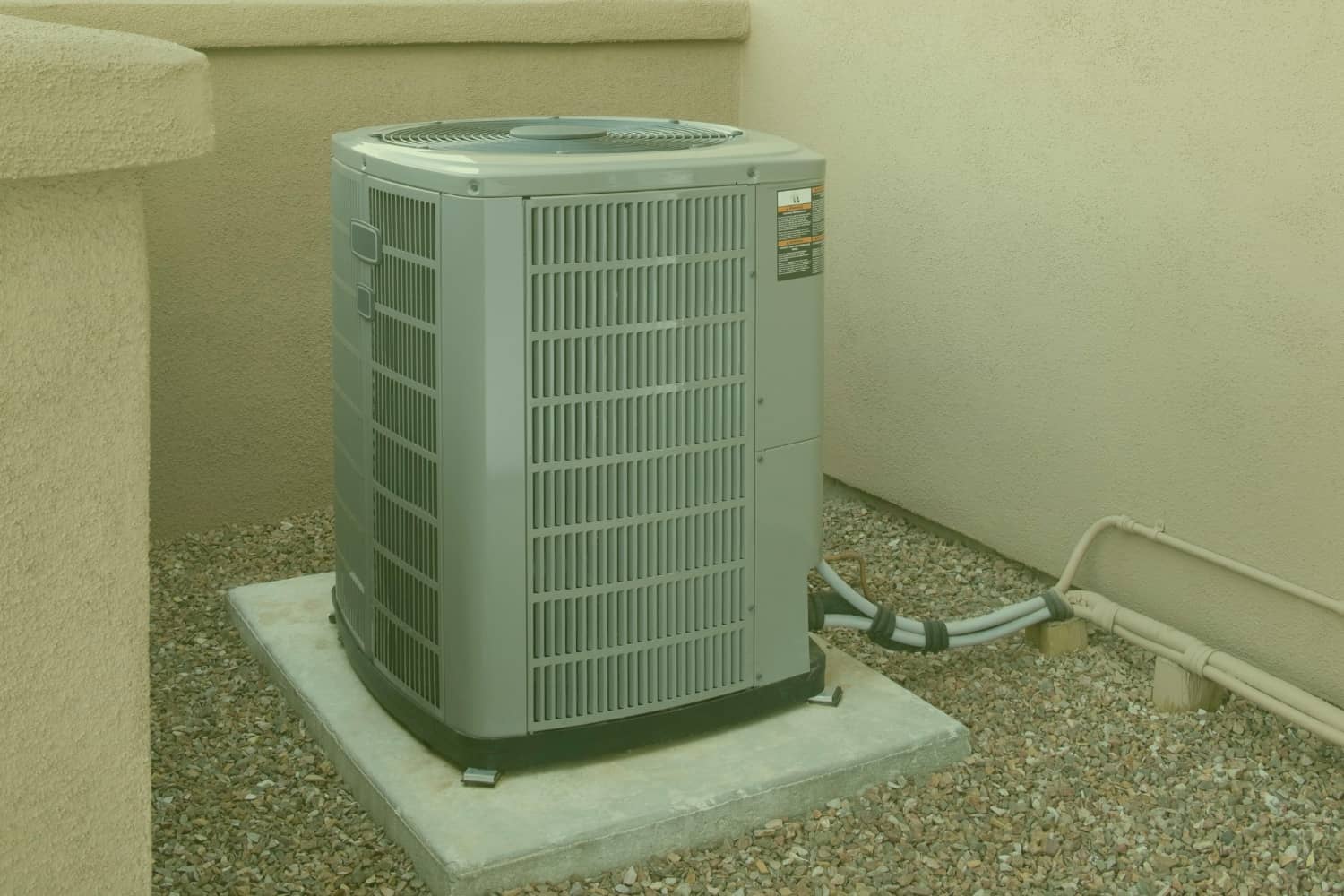
The serial number is on the data plate, a metal or foil label attached directly to the unit. On a central air conditioner, the data plate is almost always on the outdoor condenser, typically on the side panel facing the house.
On a split system, a second data plate is on the indoor air handler, usually near the refrigerant line connection.
Outdoor Condenser Unit
Check the side panels of the outdoor cabinet. The data plate is typically on the side closest to the house. Look for a rectangular label with two long alphanumeric codes: one is the model number, the other is the serial number. They are labeled on the plate.
Indoor Air Handler
Open the main access panel on the air handler (the indoor cabinet that sits above the furnace or in a closet). The data plate is usually on the blower compartment door or inside the cabinet on the side wall.
If the label is faded, covered in debris, or missing entirely, inspectors note it on the report. A missing or unreadable data plate is itself a finding, because it means the unit’s age cannot be verified from the equipment. In those cases, homeowners can sometimes trace the age through permit records or installation paperwork.
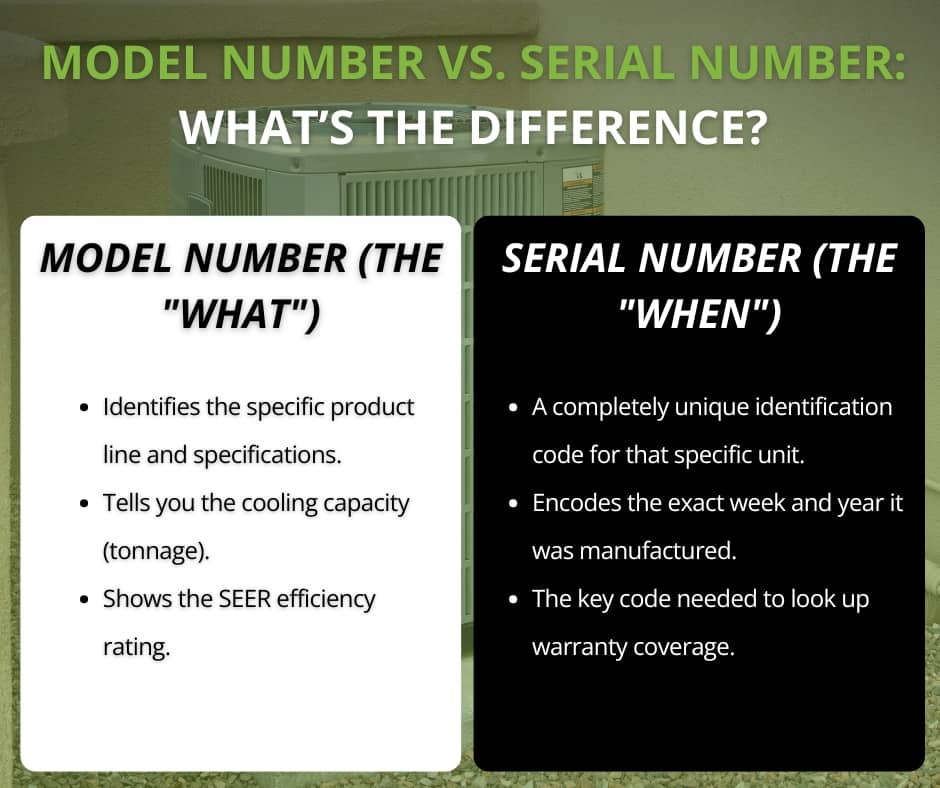
You will see two codes on every data plate. The model number describes the product and its specifications, including cooling capacity (tonnage) and SEER efficiency rating.
The serial number identifies the specific unit and encodes the manufacture date. Inspectors document both.
How to Read an Air Conditioner Serial Number by Brand
There is no universal format. Each manufacturer encodes the manufacture date differently, and many brands have changed their format at least once over the decades.
Below are the most common systems you will find on homes in Evansville, Newburgh, and surrounding southern Indiana communities.
| Brand | Serial Number Format | Example | Decoded |
|---|---|---|---|
| Carrier / Bryant | First two digits after prefix = week, next two = year | 5209XXXXX | Week 52, 2009 |
| Goodman / Amana | First two digits = year, next two = week | 1324XXXXX | 2013, week 24 |
| Trane / American Standard | 4th char = month letter (A=Jan, skip I), 5th-6th = year | XXXH03XXX | August 2003 |
| Lennox | First two digits = year, next two = week | 0540XXXXX | 2005, week 40 |
| Rheem / Ruud | First two digits = year, next two = week | 1627XXXXX | 2016, week 27 |
Carrier and Bryant
Carrier serial numbers use a letter-number format. The first two digits after any leading letters indicate the week of manufacture, and the next two give the year.
After a production update around 2020, the format shifted to begin with a four-digit year-week code. If you have an older Carrier unit with a serial that starts with a letter, skip that character and read the next four digits as week-year.
Goodman and Amana
Goodman uses a straightforward year-week scheme. The first two digits of the serial number are the last two digits of the manufacturing year, and the next two are the production week.
A serial beginning with “1324” means the unit left the factory in week 24 of 2013.
Trane and American Standard
Trane uses a letter-coded month system. The fourth character of the serial number is a letter representing the month of manufacture: A is January, B is February, and so on through M for December (the letter I is skipped to avoid confusion with the number 1).
The fifth and sixth characters give the two-digit year. A serial number with “H03” in the fourth through sixth positions was manufactured in August 2003.
Lennox
Lennox encodes the year and week in the first four digits, reading as year then week. A serial starting with “0540” indicates production in week 40 of 2005.
Rheem and Ruud
Rheem places the year and week in the first four digits as well, reading year first, then week. A serial starting with “1627” was manufactured in week 27 of 2016.
For units with faded data plates, older formats not listed here, or less common brands, the Building Intelligence Center HVAC age lookup tool maintains decoding charts for more than 30 manufacturers and is widely used by home inspectors and HVAC technicians nationwide.
What the Manufacture Date Tells a Home Inspector
Once the manufacture date is decoded, it drives several key assessments in the inspection report.
Equipment Age and Expected Lifespan
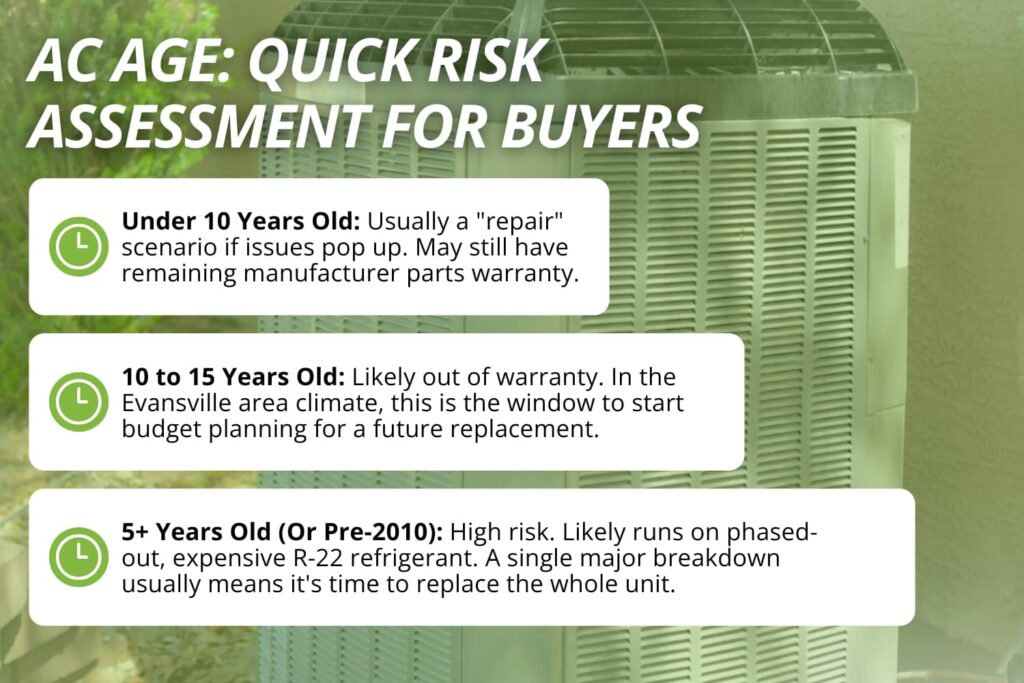
According to the U.S. Department of Energy, central air conditioners have an average lifespan of 15 to 20 years with regular maintenance.
An inspector documents the unit’s age as useful context for the buyer, not as a condemnation.
A 12-year-old system in good condition with records of annual service is not the same risk as a 12-year-old system with rust on the coil cabinet and no service history.
Age is one data point. Condition, refrigerant charge, and maintenance records round out the picture.
In the Evansville area, the humid Ohio River Valley climate puts added strain on cooling systems compared to milder markets. Both the heating and cooling seasons run hard here, which means local systems tend to reach the end of their service life closer to the 15-year mark than 20.
Our team at National Inspection Service of Indiana sees this pattern consistently in older neighborhoods across Vanderburgh and Warrick counties.
R-22 Refrigerant Implications
Units manufactured before approximately 2010 may use R-22 refrigerant. Under federal environmental rules, R-22 production was phased out, and the remaining supply has become costly to source.
If an inspection uncovers a system that still runs on R-22 and has a refrigerant leak, recharging it is expensive, and the long-term outlook is limited. The manufacturer’s date flags this risk before a buyer commits to the purchase.
Repair-vs.-Replace Context
A system under 10 years old with a minor deficiency is typically a repair scenario. A system past 15 years with a compressor failure and a repair quote approaching half the cost of a new unit is a different conversation.
Inspectors do not make that call for buyers, but the manufacture date gives buyers the context they need to have that conversation with their HVAC contractor before closing.
Warranty Implications: What Buyers Should Know
The serial number is the primary identifier for any manufacturer’s warranty lookup. Most major brands offer a 5-to-10-year parts warranty registered to the original purchaser.
When a home sells, that warranty may or may not transfer to the new owner. Policies vary by manufacturer and by whether the warranty was registered in the first place.
The inspection report documents the serial number so buyers can contact the manufacturer or an HVAC contractor to confirm the warranty status and transfer options.
This is not something the inspection can verify on-site. The serial number opens the door; a call to the manufacturer closes it.
One more detail worth noting: the manufacture date on the serial number is not the same as the installation date. A unit built in 2016 may have sat in a warehouse and been installed in 2018.
If original installation paperwork is available in the home, compare it against the manufacturer’s date. For warranty purposes, the installation date and registration date are usually what matter.
Related Questions to Explore
How do I find the serial number on my air conditioner?
Look for the data plate on the outdoor condenser unit, on the side panel facing the house. On a split system, the indoor air handler also has a data plate, usually near the refrigerant line connections. The serial number is a separate code from the model number and is typically 8 to 12 characters long. Inspectors document both during a full home inspection.
How old is too old for an air conditioner when buying a house?
Most buyers and HVAC professionals use 15 years as the point where end-of-life planning begins. The U.S. Department of Energy cites 15 to 20 years as the average lifespan for a well-maintained central AC. A 16-year-old unit may run fine for several more seasons or need replacement within a year. Age is one factor. Condition, maintenance history, refrigerant type, and efficiency ratings all contribute to the full picture.
What is the difference between a serial number and a model number on an AC unit?
The model number identifies the product line and its specifications, including cooling capacity (measured in tons) and SEER efficiency rating. The serial number identifies the specific manufactured unit and encodes its manufacturing date. Both appear on the data plate, and inspectors record both. The model number tells you what the system is designed to do; the serial number tells you how long it has been doing it.
Can I look up my AC warranty using the serial number?
Yes. The serial number is the primary identifier for manufacturer warranty lookups. Most major brands have an online portal or customer service line where you can enter the serial number to confirm the warranty period and whether coverage transfers to a new owner. Transfer policies vary widely by manufacturer. If you are under contract on a home with a newer system, it is worth confirming before closing. You can also check our post on bathroom ventilation and moisture control for another system-level issue that often surfaces alongside aging HVAC equipment.
When to Call a Professional
If your inspection report flags the air conditioner as aging, near end-of-life, or running on R-22 refrigerant, your next call should go to a licensed HVAC contractor. They can assess actual equipment condition, test refrigerant levels, and provide a realistic estimate for repair or replacement.
If you are the buyer, the inspection findings give you the documentation you need to negotiate with the seller or request a closing credit.
The National Inspection Service of Indiana team documents serial numbers for both the outdoor condenser and the indoor air handler on every inspection, so you walk away with the information you need to have that conversation with confidence.
If you are the seller or homeowner preparing to list, a pre-listing inspection gives you time to address HVAC issues before contract negotiations start.
Getting ahead of a known problem is almost always less expensive than discovering it on the buyer’s inspection timeline. For a look at another major system we assess during every inspection, see our post on what a home inspection can tell you about your foundation.
Conclusion
The serial number on an air conditioner is a small detail with real implications for buyers, sellers, and inspectors. It answers three questions that matter at the closing table: how old is this system, does any warranty still apply, and is it using refrigerant that is becoming costly to source?
A few key takeaways:
- The manufacture date is encoded in the serial number, but each major brand (Carrier, Goodman, Trane, Lennox, Rheem) uses a different format. There is no universal decoder.
- Age is context, not a verdict. An aging unit may still have useful service life; a newer unit may have serious issues. A thorough inspection documents both.
- The serial number opens the door to warranty verification. A call to the manufacturer closes it.
If you are buying or selling a home in Evansville, Newburgh, or surrounding southern Indiana, a detailed home inspection is the clearest way to know what you are working with. Schedule your inspection with National Inspection Service of Indiana and get the full picture before you sign.